
The Fed holds steady: what it means for you
Posted on 29 October 2026On Wednesday, October 28, the Federal Reserve left its benchmark interest rate unchanged, in a range of 3.75% to 4.00%. That’s where it has been since a quarter-point increase in September. The vote was 10 to 2, and both dissenters wanted to raise rates again.
The Fed’s statement was short and direct. The economy “is expanding at a strong pace,” and job gains have kept pace with the workforce. But “inflation remains elevated.” The Fed said it wants more information before its next step, and it closed with a plain line: “The Committee will deliver price stability.”
At his press conference, Chair Kevin Warsh noted that inflation has been running above the Fed’s 2% goal “for close to 6 years,” and that energy prices have moved higher again in recent weeks. He also said the Fed has made clear its “readiness to act as circumstances require.”
With the Chair stepping back from forward guidance and reaffirming that the Fed will deliver price stability, we expect the Fed’s next steps to depend on the data, with a slight bias toward raising rates if needed. In the weeks ahead, markets will be focused on key earnings reports, along with October’s employment and inflation data.
What might this mean for you? Investors should continue to expect volatility in markets, along with higher correlations, meaning stocks and bonds moving more closely together. As the Chair himself noted, markets have seen “bouts of volatility and shifting correlations,” and we anticipate that to continue.
The directional bias for rates is higher. For much of the last fifteen years, very low interest rates were the norm. We may now be in a different environment, where rates stay higher for longer, and that affects borrowing costs, cash, and how bonds behave.
That’s why we think it’s important to diversify thoughtfully. When stocks and bonds sometimes move in the same direction, owning both may not provide as much balance as it once did, so we think about diversification more broadly than stocks and bonds alone.
A word on AI infrastructure
Another theme worth putting in context is artificial intelligence. Many AI-related stocks have pulled back over the last few months, but the businesses behind them tell a different story. According to research from Infrastructure Capital Advisors, analysts’ consensus earnings estimates for 2028 for the seven largest AI “hyperscalers,” the companies spending heavily to build out AI infrastructure, rose an average of about 40% over the past 12 months, and every one of the seven moved higher.
Share prices haven’t kept pace. Over the same period, the group’s stocks rose only about 4% on average, so their average price-to-earnings ratio on 2028 estimates fell from 20.4 to 15.4. In other words, expectations for these businesses have grown much faster than their stock prices. It’s a useful reminder that a pullback in share prices doesn’t necessarily mean the underlying businesses are struggling. Earnings estimates can change, and these companies still carry real risks, which is one more reason we think carefully about diversification.
If analysts now expect the hyperscalers’ 2028 earnings to be about 40% higher than they did a year ago, what might that mean for the companies that supply them? Those suppliers include makers of memory chips and other semiconductors, along with networking equipment, electrical and power equipment, and data center cooling. Many of these stocks have pulled back even more than the hyperscalers themselves. Revolutionary advances in technology have often come with significant volatility, and AI-adjacent industries are no exception.
None of this calls for sudden changes. At CWM, we are allocating with these points in mind. If you’d like to talk about what it means for your own plan, Hayden or I would be glad to hear from you.
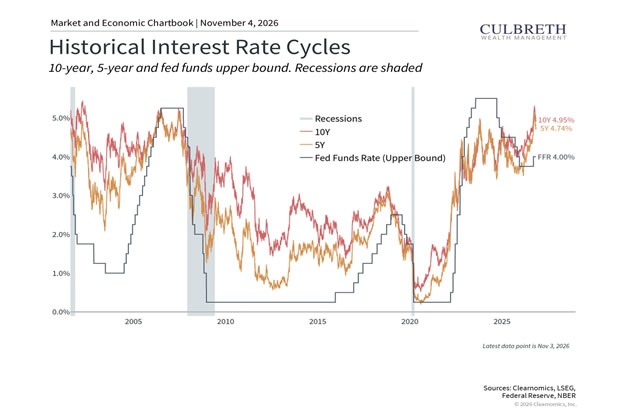
Historical interest rate cycles: 10-year and 5-year Treasury yields and the fed funds rate upper bound, with recessions shaded
Sources: Federal Reserve, FOMC statement, Oct. 28, 2026; Federal Reserve, Transcript of Chairman Warsh’s Press Conference opening statement (preliminary), Oct. 28, 2026; CNBC, “Fed holds rates steady,” Oct. 28, 2026; Infrastructure Capital Advisors, “Hyperscaler earnings estimates are rising while their valuations are falling,” market commentary, Oct. 30, 2026, based on Bloomberg consensus 2028 EPS as of Sept. 30, 2026. Chart: LSEG, Federal Reserve, NBER.
This communication is for educational purposes only and is not investment, tax or legal advice. Culbreth Wealth Management is a registered investment adviser.